Found a bat? We're here to help — call us NOW: 512-695-4116 or 512-799-8847
Habitat in Crisis

The Palm Trees Austin’s Bats Depend On

Palm trees are vital habitat for Austin’s yellow bat population and can host up to four other local bat species. Winter Storm Uri (2021) destroyed over 90% of them.

Yellow bats roost ONLY in the brown skirts of palm trees – at minimum 12 feet above the ground. There is no substitute.

When the skirts are pruned, yellow bats lose their home. There is no bat box, no tree cavity, no alternative structure that replaces what a palm skirt provides. Every palm skirt that gets removed is a roost site permanently destroyed.

90%+
of Austin’s palms killed
Winter Storm Uri in February 2021 wiped out the majority of Austin’s palm trees – the primary roosting habitat for yellow bats.
5
bat species per palm
A single palm tree with its skirt intact can simultaneously host up to five local bat species. The density of habitat value is extraordinary.
20+
bird species also depend on palm skirts
Palm skirts aren’t just for bats. Over 20 bird species also use palm skirt habitat for nesting and shelter.

Palm trees are vital habitat for Austin’s yellow bat population and can host up to four other local bat species. To our knowledge, yellow bats roost nowhere else but the brown skirt of palm trees, which hangs below the green crown of live fronds. We’re talking about palms where the bottom of the skirt is at least 12 feet above the ground, allowing bats to drop into flight above the reach of leaping predators.

Winter Storm Uri (The Feb 2021 Freeze Event) had a devastating effect on Austin’s palm trees, with over 90% being killed. This makes the skirts on the surviving palms critical to the survival of the two species of yellow bats. We can minimize the harm to our local bats with careful analysis and best management practices, if palm tree work cannot be avoided and just has to be done.

Austin palm trees at night with bat habitat brown skirts visible under the green crown

The brown skirt under the green crown is home to yellow bats in Austin.

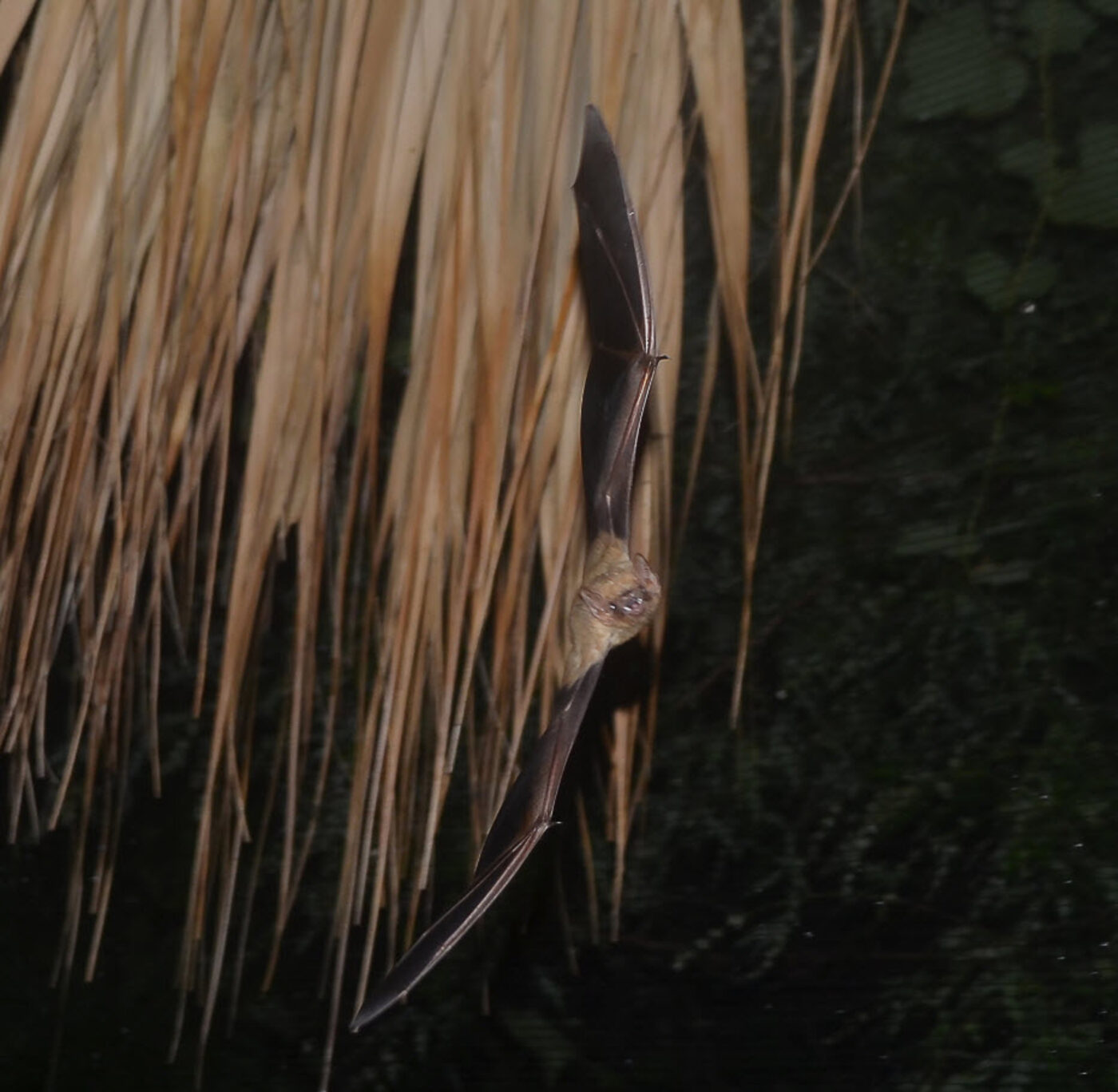
Two species of yellow bats roost in the skirts of Austin’s palm trees – northern yellow bats and southern yellow bats. Watching them fly out at night from your palm tree is a natural wonder. Set up the lawn chairs, crank up the margarita machine and invite the neighbors. Add a bat detector and you have a back-stage pass to the best of Austin’s wild nightlife! If you don’t have a palm tree, our Instagram account @austinbatrefuge has tons of great videos where you can get to know them. Give us a follow!

If you own a palm and want some cover as to why you aren’t pruning the skirt, then purchase one of our yard signs and proudly proclaim you support for Austin’s yellow bats!
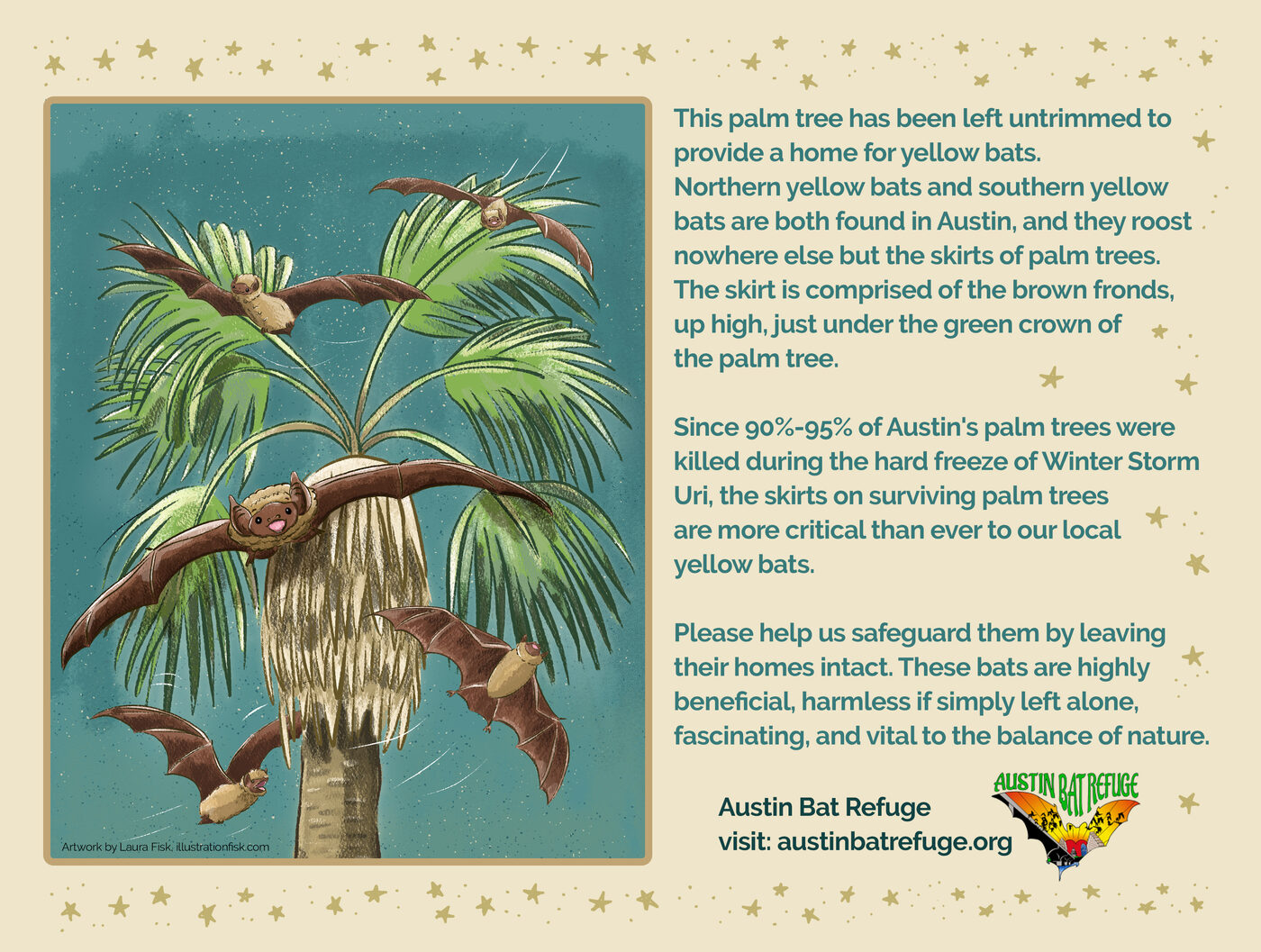
Austin Bat Refuge yard sign: This palm tree has been left untrimmed to provide a home for yellow bats
Understanding Yellow Bats

Two Species, One Roost

Austin is home to two yellow bat species: the Northern Yellow Bat and the Southern Yellow Bat. The Southern Yellow Bat expanded its range north into Austin within the last five years. Both species roost exclusively in palm skirts.

Northern Yellow Bat

The resident species. Can be watched flying out at night from palm trees. Gives birth in palm skirts; nursing non-flying pups are present from mid-May through August – never prune during this window.

Southern Yellow Bat

A recent arrival in Austin’s urban landscape, moving north as the climate shifts. Uses the same palm skirt habitat. Finding both species in a single tree is not uncommon.

Bats sleep deeply even on warm summer days. Winter torpor occurs despite warm spells because their biology responds to day length and light levels, not just temperature. A warm day in January does not wake them up.

“Birds Bolt – Bats Don’t.” If you disturb a roost, birds scatter instantly. Bats stay put. This is not a sign that the bat is unhealthy – it is a species-level behavioral difference that surprises many people.

Documented Harm from Palm Pruning

These are not abstract concerns. They are documented, recurring injuries that happen every pruning season in Austin:

Compound wing fractures from tree removal equipment contacting roosting bats. The bones in a bat’s wing are extraordinarily fine – a glancing blow from a chainsaw or chipper can shatter them irreparably.

Orphaned non-flying pups found helpless on the ground after skirt removal during maternity season. Pups born mid-May cannot fly until late July at the earliest. A pruning event in June finds them at their most vulnerable.

If you see a grounded bat during or after tree work: call 512-695-4116 immediately.

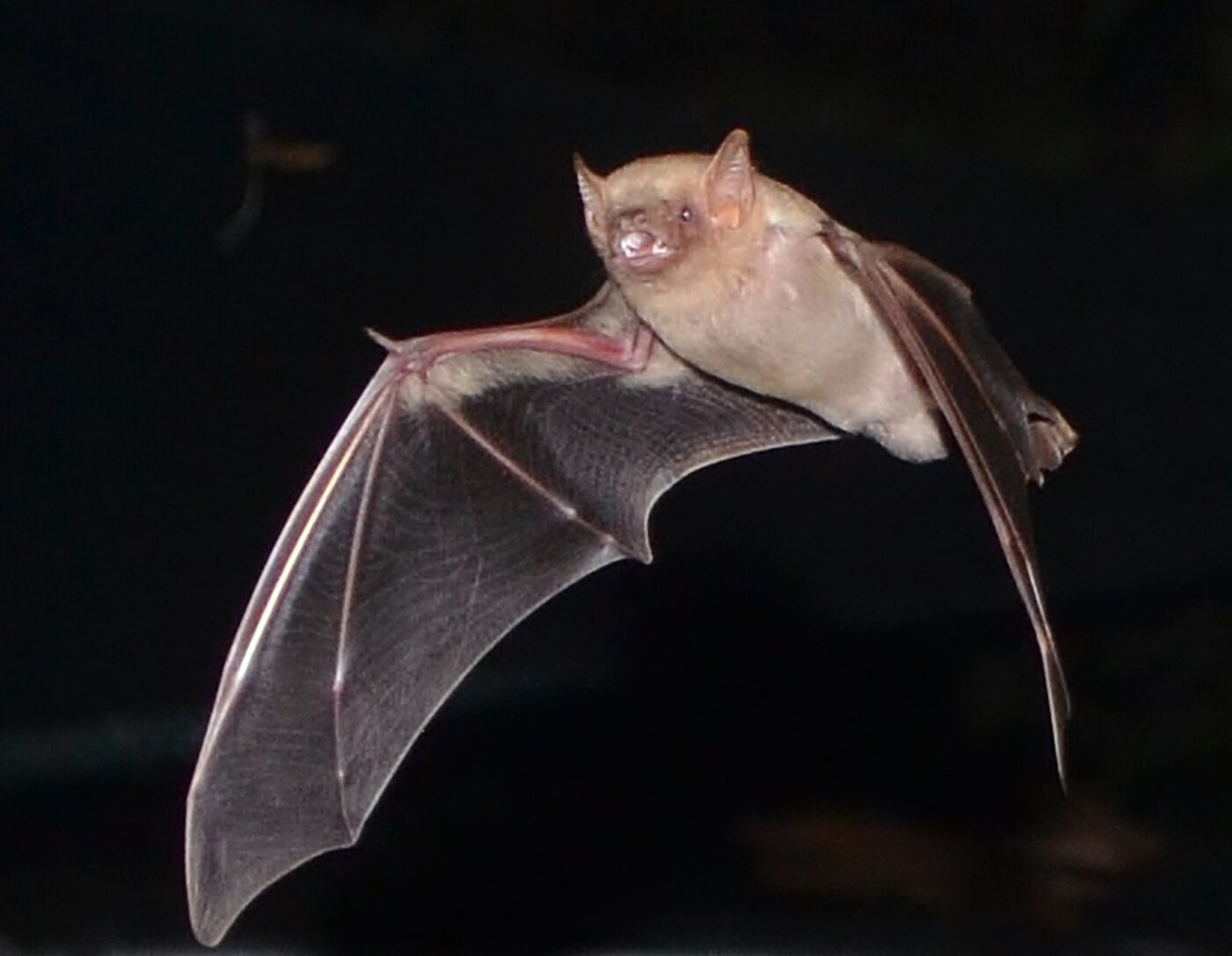
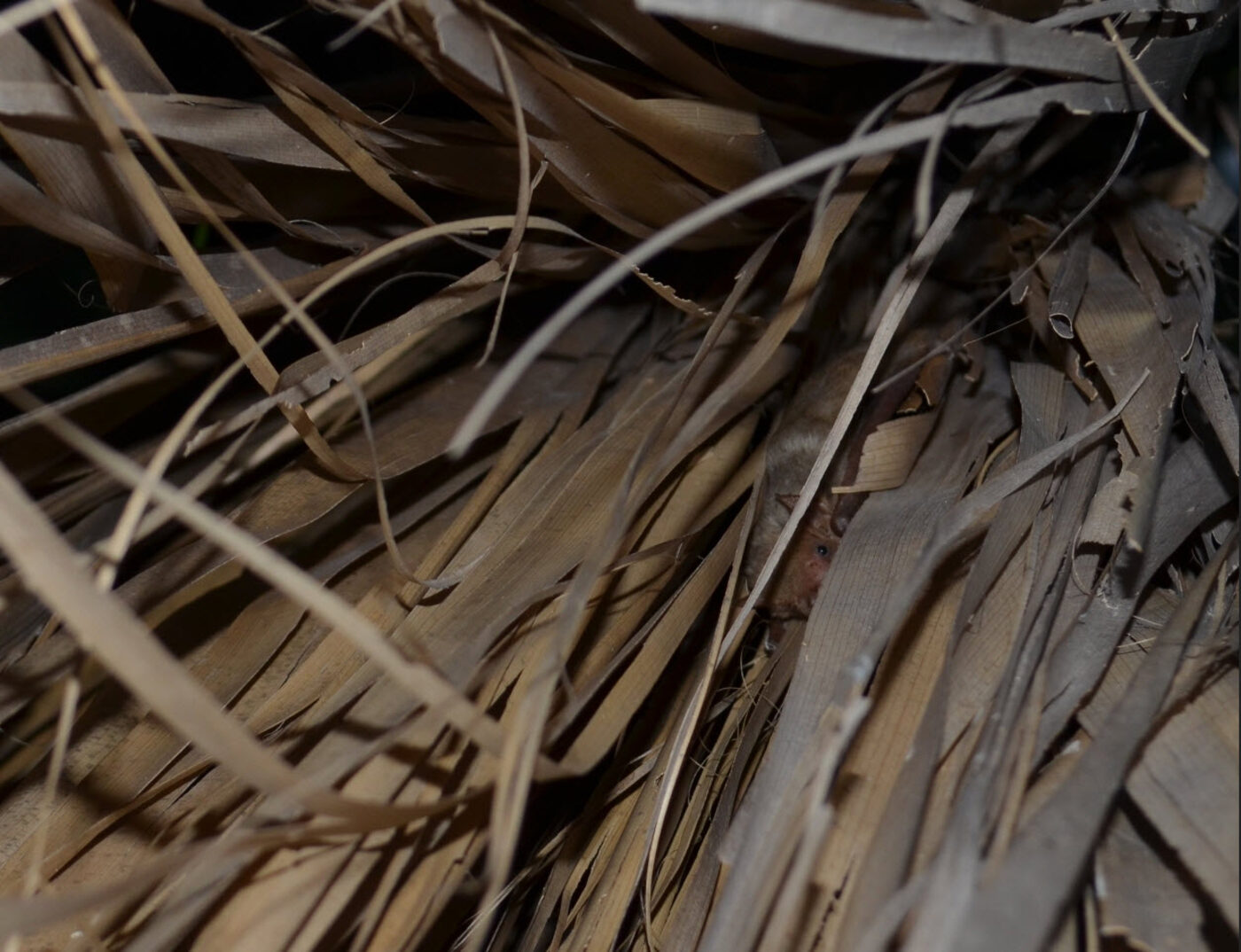
Southern yellow bat roosting in palm skirt fronds

southern yellow bat

Southern yellow bat pup in rehabilitation care

southern yellow bat pup

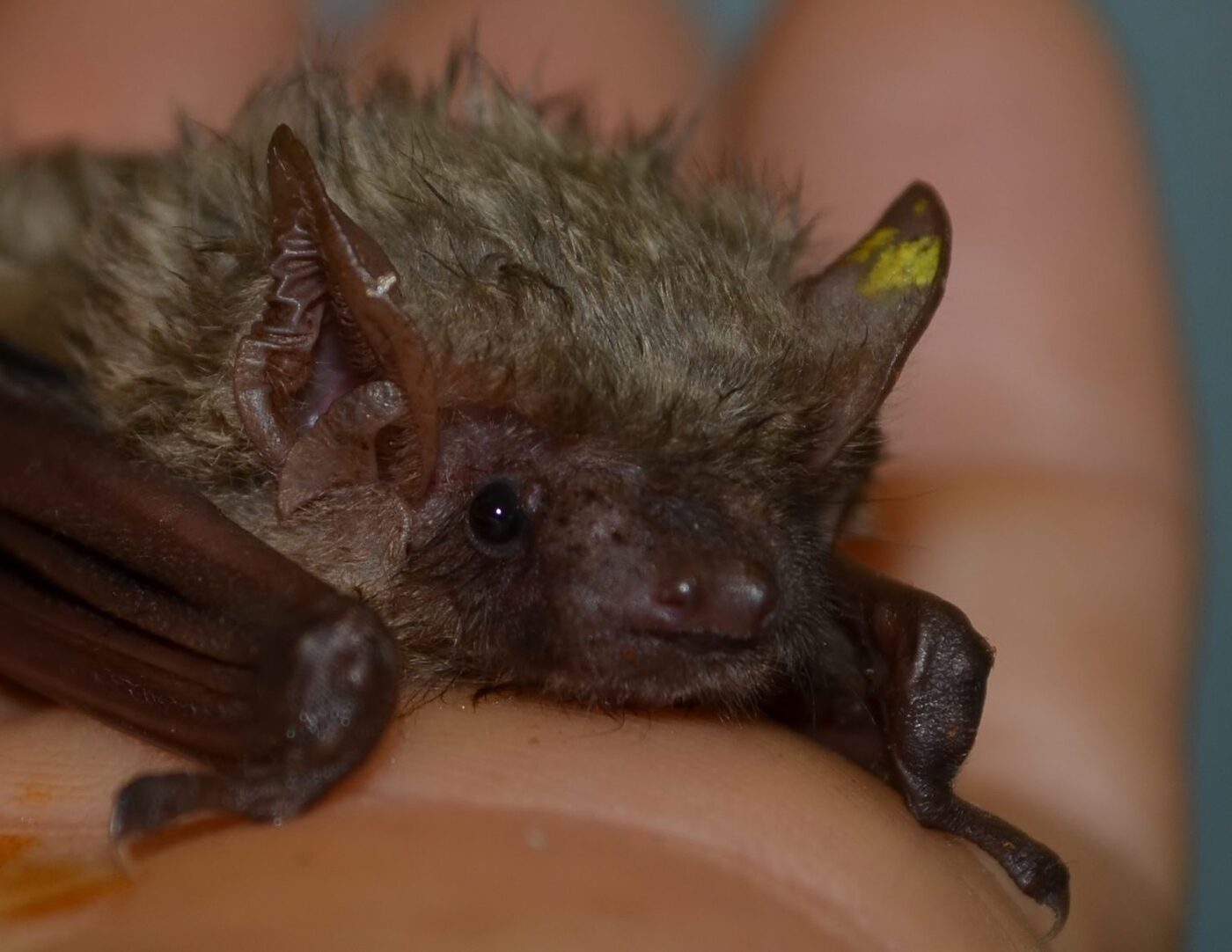
Northern yellow bat pup - tiny, helpless without its mother

northern yellow bat pup

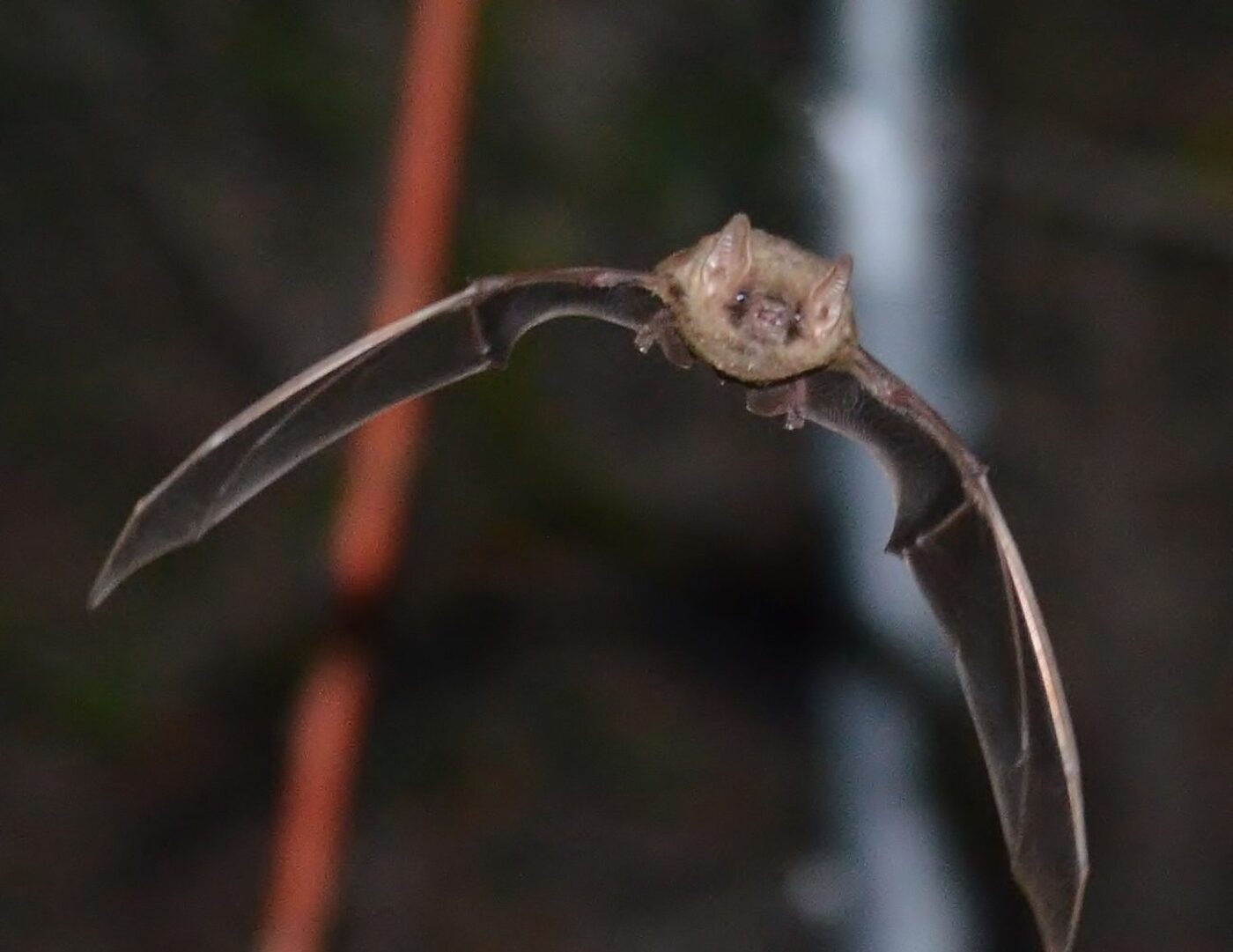
Northern yellow bat juvenile in flight

northern yellow bat juvenile

This skirt is valuable habitat for a variety of other wildlife too, including over 20 species of birds. They all love this habitat because they can roost out of the sight of predators, which means they won’t be easily seen by humans either.

Please be aware that yellow bats give birth in these skirts and will be nursing non-flying pups from mid-May through August. Tree work that involves the skirt of the palm tree will injure or kill bats, and orphan the non-flying pups if their mother is scared away by her roost being demolished. Bats feel safe in palm fronds and generally will not flush at signs of danger. “Birds Bolt – Bats Don’t”. They are deep sleepers (even on warm summer days) and, on top of that, will be in torpor during the winter, even during warm spells, due to short days and low light levels.

We have seen this many times in the last decade. People are unaware there are bats in their yard until a palm tree is removed “lumberjack style” and they find bats with compound fractures of the wing amongst the pieces of fallen palm tree. Or a palm skirt is pruned during maternity season and non-flying yellow bat orphans are found helpless on the ground. Please don’t let this happen to you or your bats.

Palm Species Guide

Native vs. Introduced Palms

Palm trees don’t need to be “manicured” and are best left alone for their longevity and health. Native palms such as our Sabal mexicana and introduced palms such as Sabal palmetto stand up very well to wind events and giving them a “Hurricane Cut” (removing the skirt of old fronds also acts to insulate the trunk of a palm against freeze events such as that caused by the Feb 2021 Polar Vortex) does not make them any more resistant to storms.

For a great primer on local Austin palm trees, see Identification of Palm Trees in the Austin, Texas Area: A Casual Guide for Distinguishing our Native Sabal mexicana from the Aliens by late, great and witty, Landon Lockett.

Native – Best Choice

Sabal mexicana

The gold standard for bat-friendly palm planting in Austin. Native to the Texas coast and Gulf region. Provides excellent skirt habitat, handles Texas winters better than most palms, and supports the broadest range of wildlife. Plant this one.

Native

Sabal palmetto

Native to the southeastern US. A good second choice where Sabal mexicana isn’t available. Provides comparable bat habitat and is widely available at Texas nurseries.

Introduced

Washingtonia filifera (Desert Fan Palm)

The most common palm in Austin before Uri. Still provides valuable bat habitat when skirts are left intact. Note: fronds have thorns on the petioles – wear proper protection during any necessary maintenance work.

Introduced – Recent Arrival

Washingtonia robusta (Mexican Fan Palm)

Tall, fast-growing, and widely planted. Also provides bat habitat when skirts are intact. The narrow trunk and height can make inspection difficult – use a bucket lift for any work near the crown.

Freeze protection: Skirts provide insulation to the growing crown during events like Winter Storm Uri. Pruned palms are more vulnerable.
Hurricane resilience: Contrary to popular belief, palm skirts do not increase wind risk. Studies show they have minimal effect on structural integrity in high winds.
Tree health & longevity: Natural skirts protect the trunk from physical damage and temperature fluctuations, extending the life of the tree.
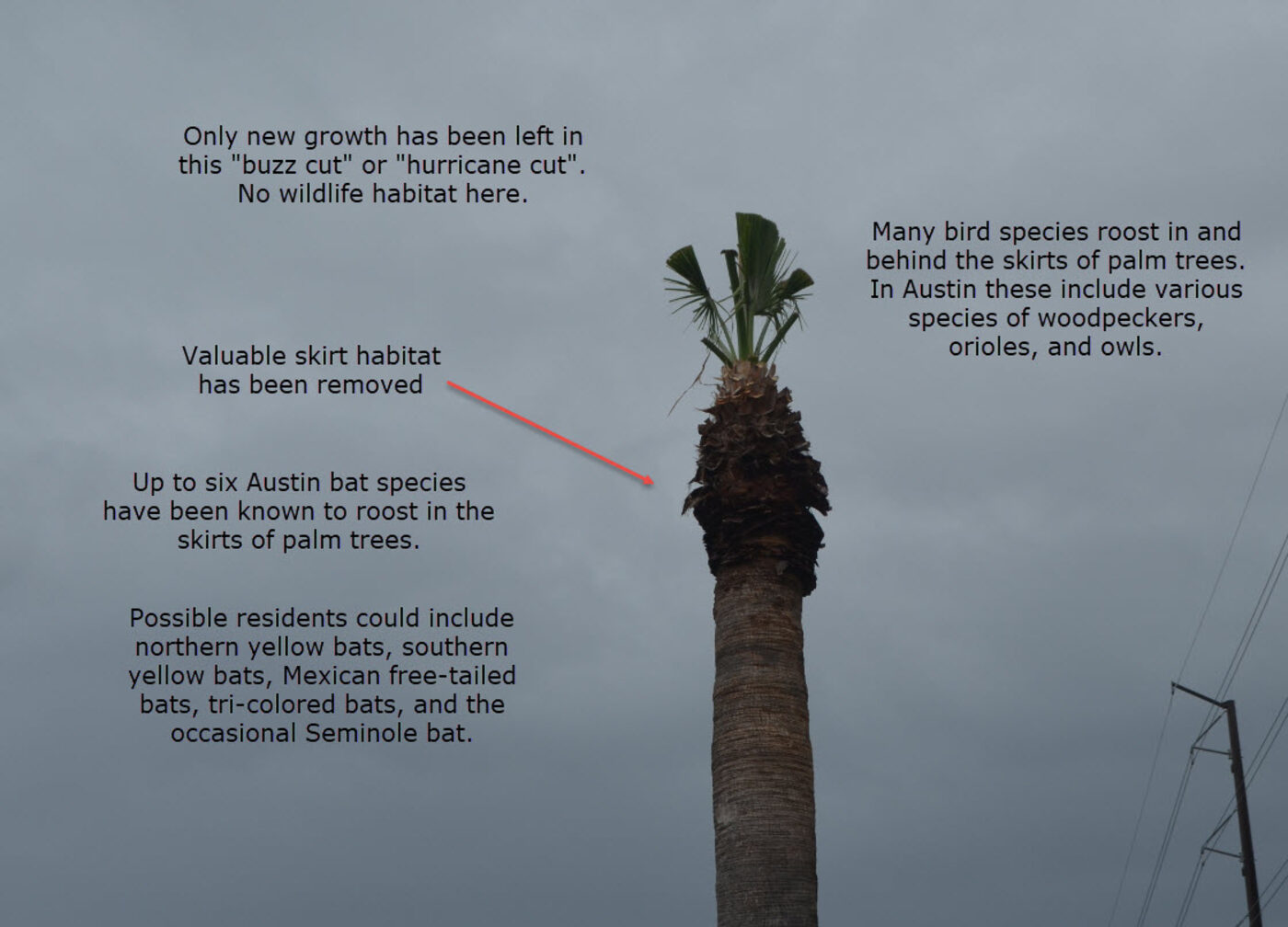
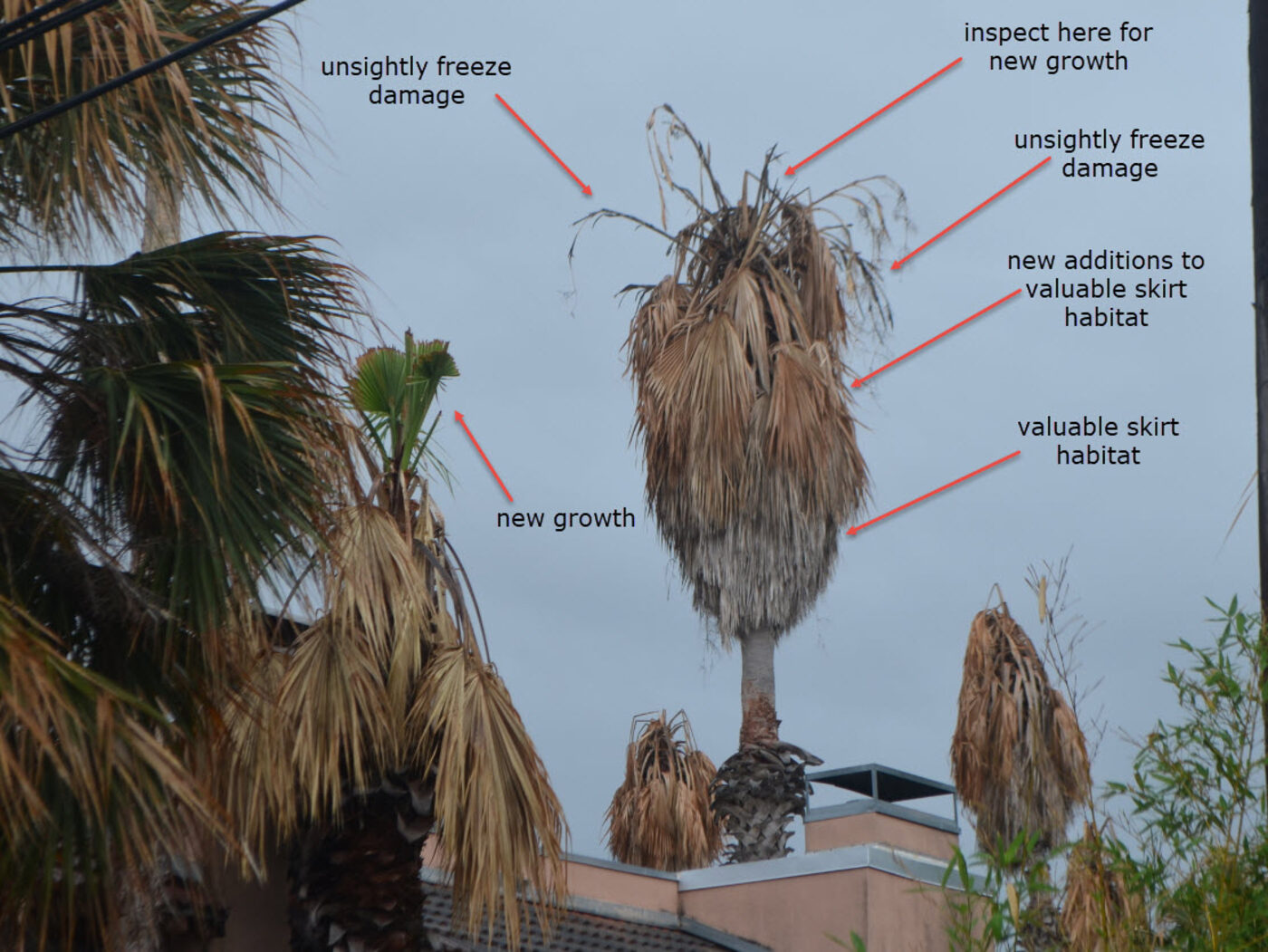
Palm tree with unsightly freeze damage labeled - showing what can be safely removed vs. valuable skirt habitat that must stay

We’re seeing lots of unfortunate pruning around town.

Palms can be selectively pruned to remove the freeze damage while maintaining the skirt that has been forming over years and that provides critical habitat for as many as six of our local bat species. The new freeze damage has an unruly appearance, like windblown or frizzy hair and we contend that those fronds can be removed (if absolutely necessary) while leaving the skirt (and its valuable habitat) intact. PLEASE LEAVE THE SKIRT!

Palm tree with annotations showing valuable skirt habitat, new growth, and unsightly freeze damage - inspect for new growth before pruning

Please leave the skirt if work just has to be done.

If palms are far enough away from buildings or foot traffic, they would not seem to pose a liability issue for property owners, but of course it is up to the property owner to determine this. We only ask that wildlife be considered and that if at all possible, habitat be preserved.

When Tree Work Is Unavoidable

Best Management Practices

If palms are dead and need to be removed, or pruning must happen, follow these steps to minimize harm to roosting bats.

Use a Bucket Lift – Never Climb

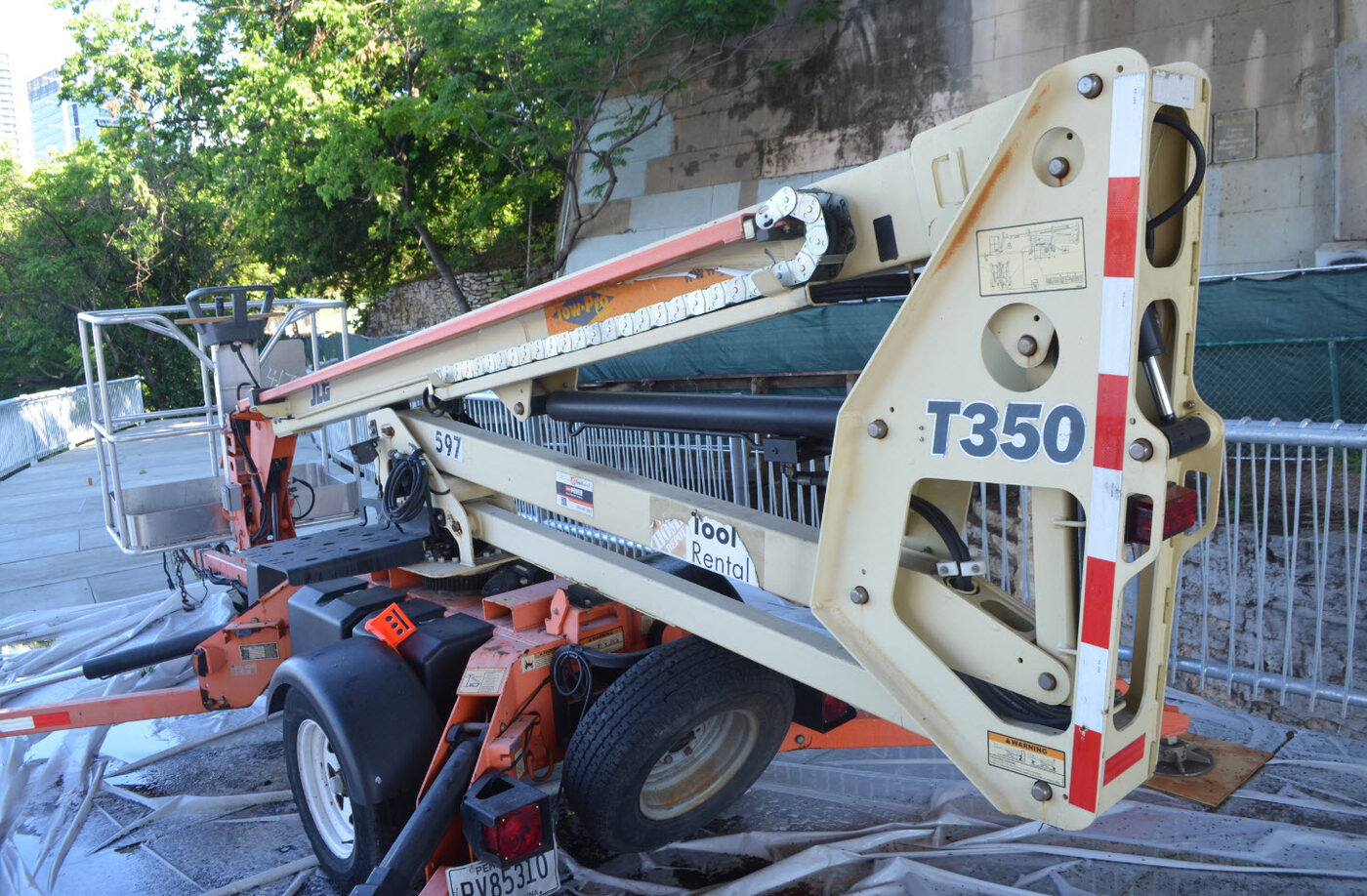
A JLG T350 bucket lift rents for approximately $216 for four hours. It is 4’9″ wide and reaches 40 feet – sufficient for most palm work in Austin. Climbing palms is a worker safety risk: dead and dying palm stems are mushy and can fail without warning.

JLG T350: ~$216 / 4 hours · 4’9″ wide · 40-foot reach
JLG T350 bucket lift for palm tree bat-safe pruning - available for rent at tool rental shops

Make sure your arborist will be using a lift. A lift such as the JLG T350 pictured above can be rented for $216 for four hours and is easily maneuvered into most locations. It is only 4 feet 9 inches wide but allows cutting at 40 feet in height.

Lower Fronds with Thin Rope

Do not drop fronds from height. Use a thin rope to lower each frond section slowly to the ground. A frond that drops freely can injure a roosting bat mid-fall. Inspect every frond thoroughly before sending it to the chipper.

Use a Strong Light – Check Deep Recesses

Bats hide in locations that are easy to miss on a quick visual pass. Use a bright flashlight or headlamp to examine every recess before proceeding. Key hiding spots: double pleats, cones, frond shoulders, and plain sight along the frond midrib.

Work from Above

Always work from above the roost zone where possible. Approaching from above is less disturbing to roosting bats than working from below and gives you better visibility into the hidden areas of the skirt.

Wear proper arborist clothing – Washingtonia palms have thorns.

Know All the Hiding Spots

Bats in palms use predictable micro-habitats. Before cutting any frond, check: between two fronds, frond shoulders (where the petiole meets the trunk), double pleats in dead fronds, cone formations at the top of the skirt, and sometimes completely in plain sight along a frond.

Where Bats Hide in Palm Fronds

Bats hide in palm fronds for protection against predators. At a minimum, they will be between two fronds, but often they wiggle up into areas not noticeable at first glance. These areas include the shoulders of palm fronds, double pleats, and cones. See the following video for an example of a bat in a cone formation of a sabal palm frond.

Southern yellow bat hiding in a cone formation of a sabal palm frond.

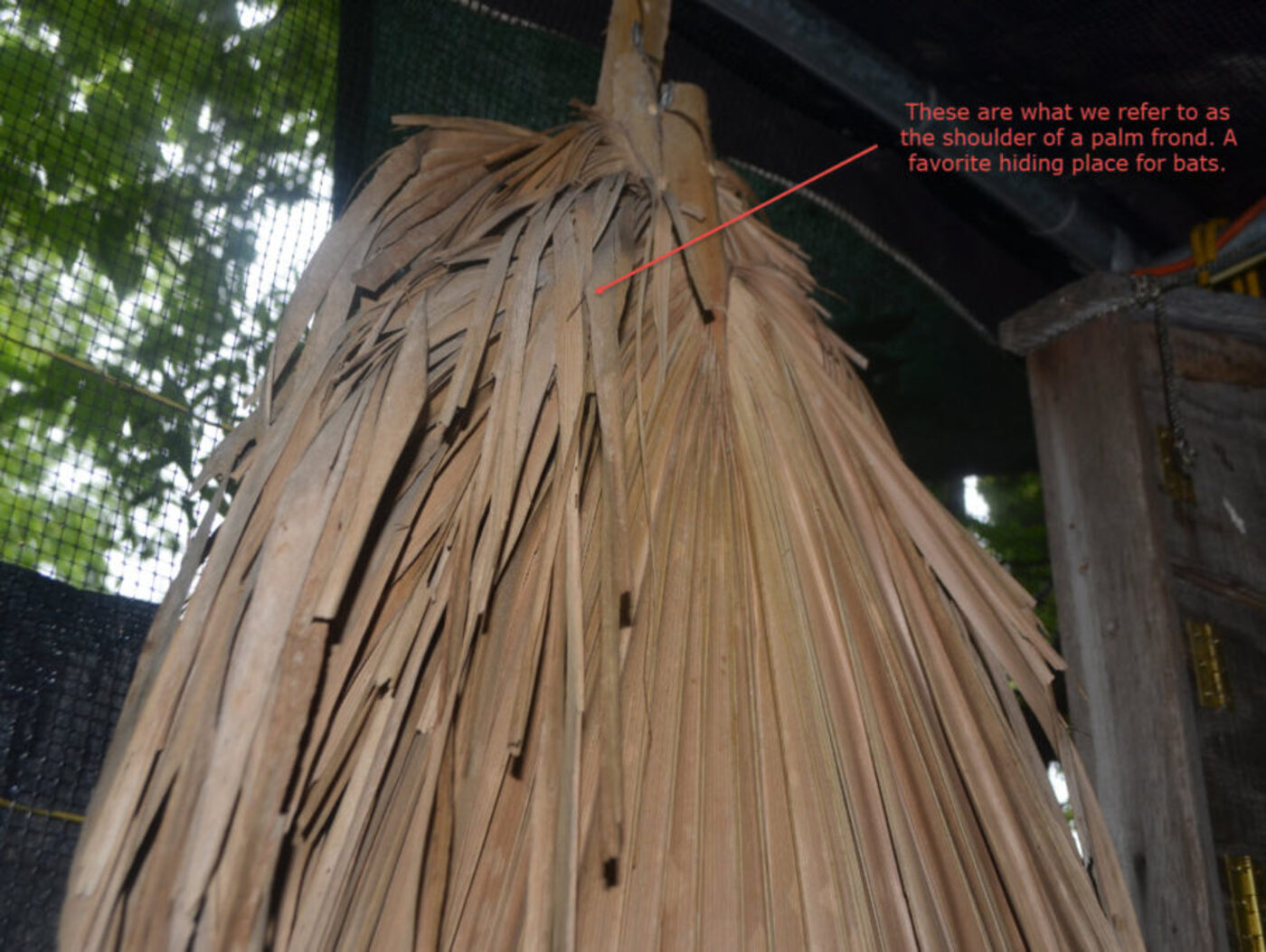
Palm frond shoulder - a favorite hiding place for bats, labeled diagram

Above is an example of a palm frond shoulder, another favorite hiding place for bats.

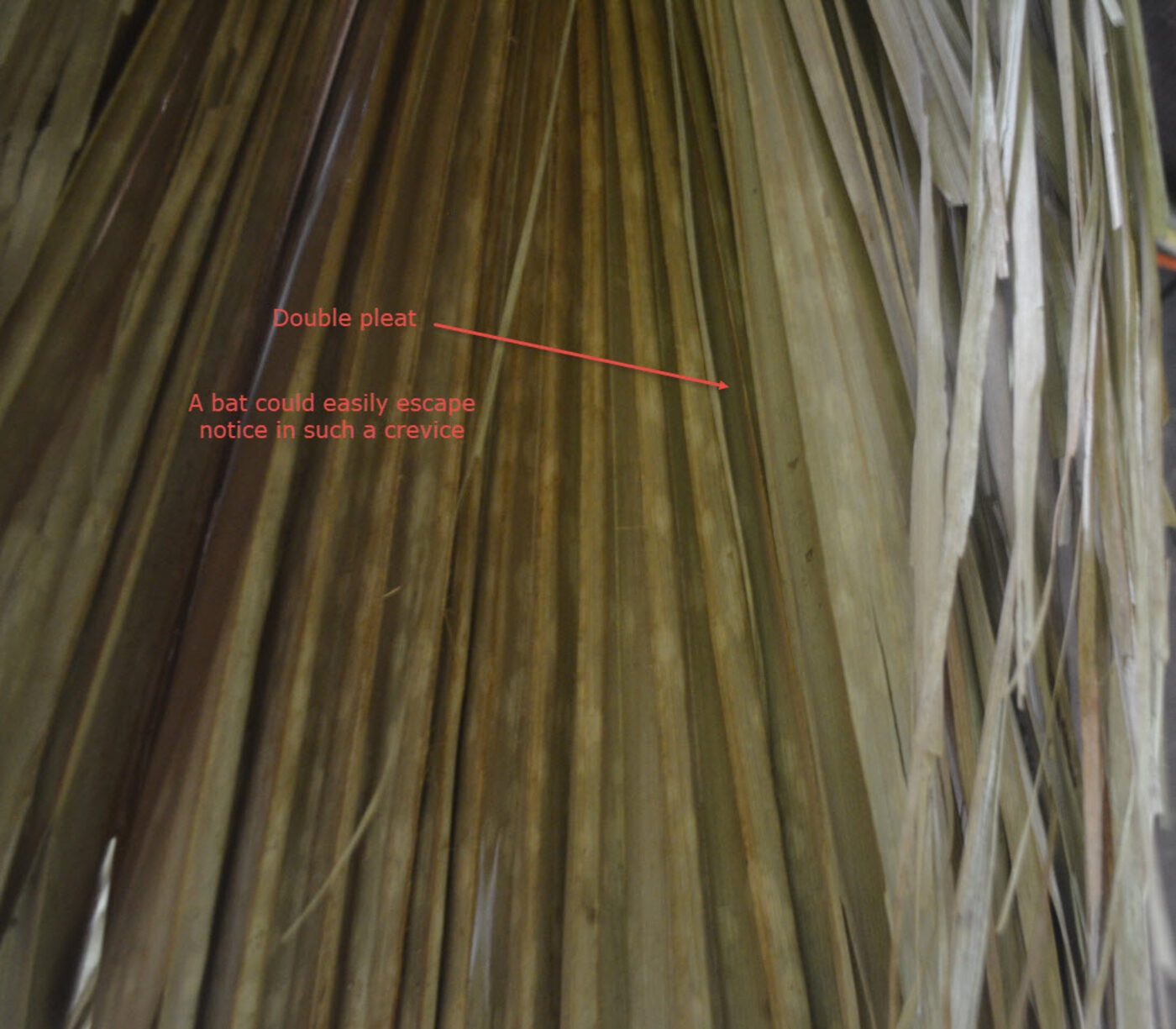
Double pleat in a palm frond - bats love to hide in these crevices Palm frond double pleat detail - a bat could easily escape notice in such a crevice

Above is an example of a double pleat, in which bats love to hide. Tri-colored bats are especially fond of these crevices.

Even in Plain Sight

Even in plain sight, they can be hard to spot. Can you find the bat?

Family on bikes on a sidewalk - a yellow bat blown from a palm is on the ground nearby, easy to miss

This family found the yellow bat below, blown out of a palm by a blue-norther. Dogs often sniff out fallen bats, so keep them on a short leash!

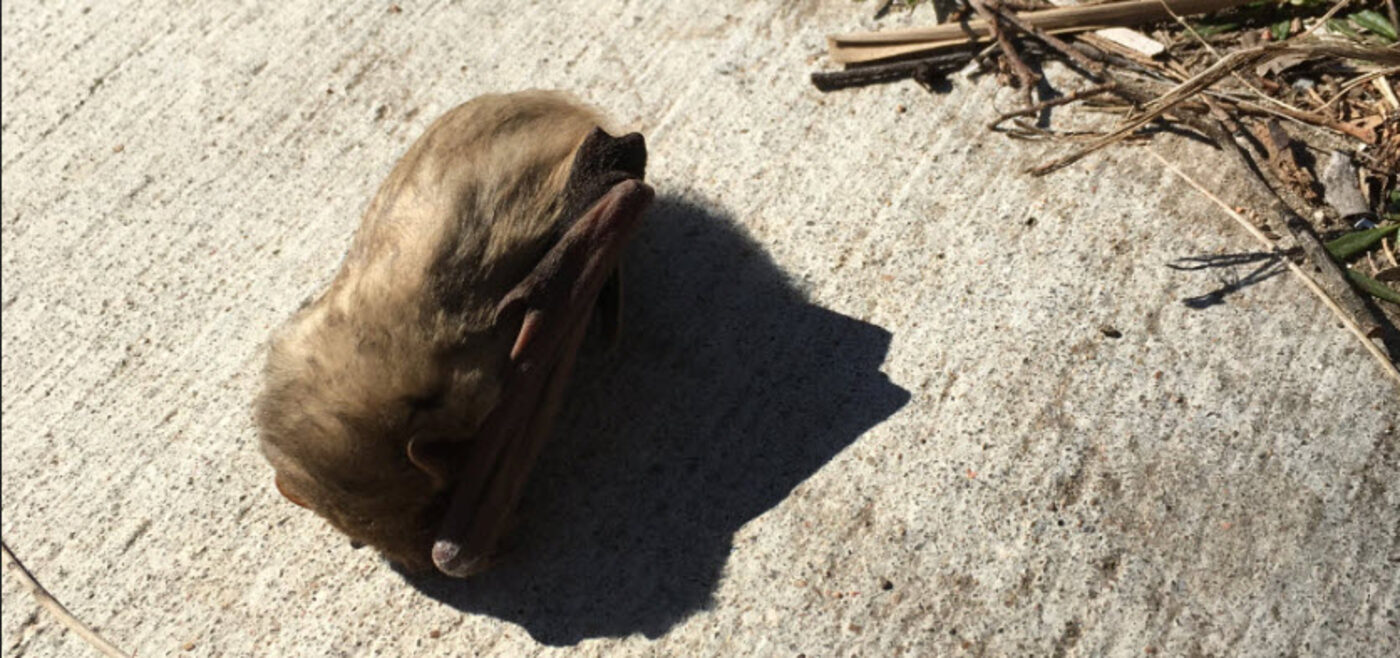
Northern yellow bat on the ground after being blown from a palm tree - still in torpor

Northern yellow bat blown out of palm tree on a cold winter day. She’s still in torpor (and maybe stunned) after hitting the ground.

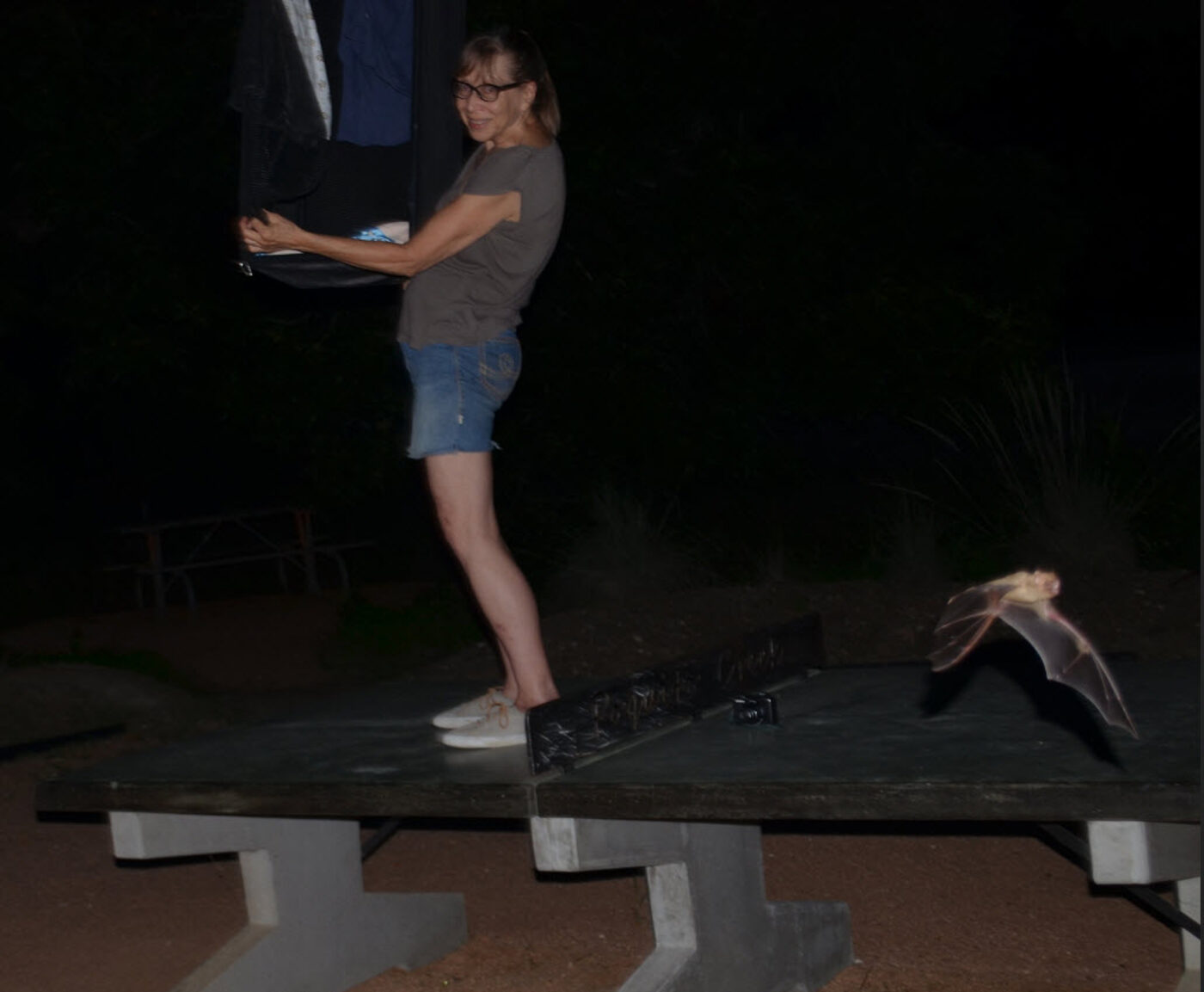
Dianne, co-founder of Austin Bat Refuge, releasing a northern yellow bat back to her palm tree at night

Dianne, co-founder of Austin Bat Refuge, releasing that same wild girl back home.

Maternity Season: Never prune palm skirts between mid-May and August. Non-flying pups are present during this window and cannot survive without their mothers. Any work during this period will result in orphaned or injured bats. If you witness tree work during this window, call us immediately: 512-695-4116

How to Help

You Can Help

With 90% of Austin’s palms gone, every surviving tree is critical. Here’s what you can do.

Make Your Palm a Bat Refuge

We’ll be looking for good release sites! Volunteer your palm tree as a bat rehoming site for displaced bats.

Become a Yellow Bat Advocate

Help change the aesthetic. Palm trees don’t look right without a skirt. We call that the Strip Club Cut!

Lobby Your HOA

Lobby your Home Owners Association to not require pruning of palm trees.

Talk to Apartment Managers

Ask your apartment managers to leave the skirt of palm trees on the property for wildlife habitat.

Monitor During Tree Work

Keep an eye out for grounded bats if tree work is done around your residence. Call us if you see one: 512-695-4116.

Spread the Word

Spread the word to professional organizations such as Property Management Associations, Apartment Manager Associations, Arborist Associations, and Real Estate companies.

Praise Good Stewardship

Praise the City of Austin Public Works, Watershed Protection, and Parks and Rec for agreeing to care for bats when maintaining palms. Thanks y’all!

Plant Native Sabal mexicana

The best replacement for lost palms. Available at Texas native plant nurseries. Every new palm planted is future bat habitat.

My Palm Tree is Bat Habitat

If you’d like to volunteer a palm tree on your property to be a rehoming site for displaced bats, please fill out the form below. Please only fill out this form if you live in Texas, preferably the area around Austin.

View Form → Or call: 512-695-4116

Support the Bat Refuge

Our education table at Congress Avenue Bridge is staffed entirely through donations. Help us keep the wonder alive.

Donate to Austin Bat Refuge →
Found a Bat? 512-695-4116 Donate →