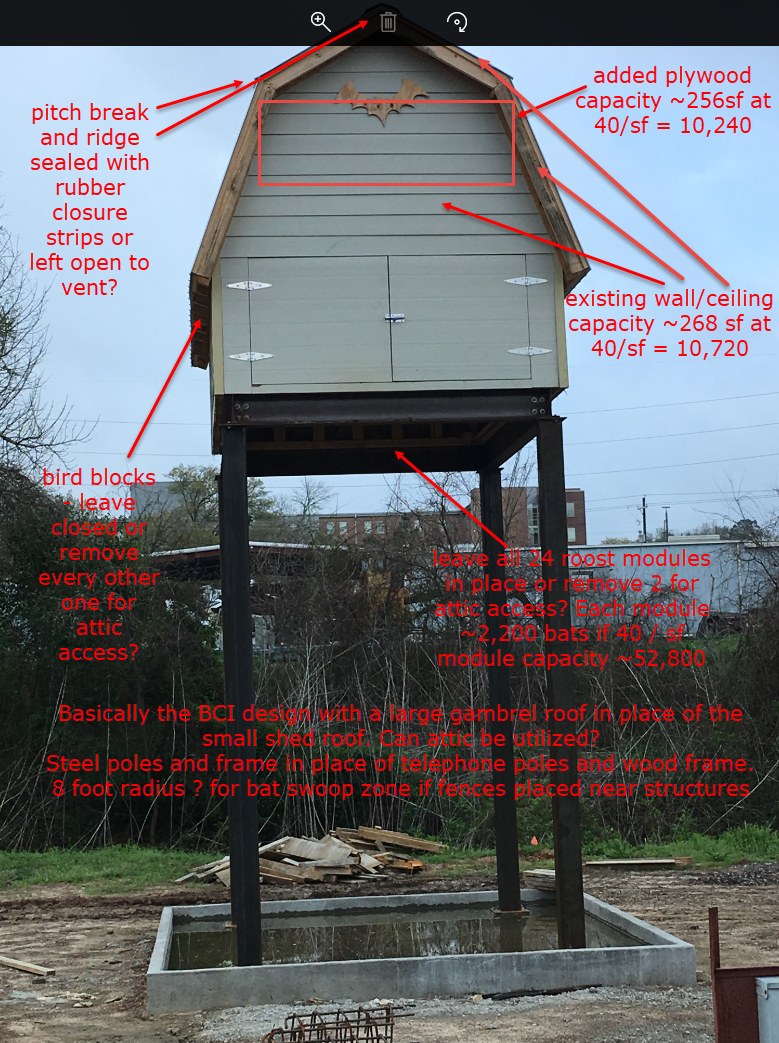
Despite almost ten years of reasoning, bargaining, scheming, and collective effort from many agencies and NGOs, the Huntsville bat colony apparently will be evicted. At this time, TDCJ appears to be unwilling to accomplish this in a 3-4-year reasonable exclusion process.
The Texas Department of Criminal Justice has unfortunately never considered leaving the former cotton warehouse that housed the bats as a natural roost and tourist attraction. The latest meeting between our working group and the TDCJ revealed that TDCJ’s consulting engineer had condemned the warehouse, and signaled their unwavering intent to eventually demolish the structure.
Failure to repair broken windows and replace missing doors has allowed the bats to colonize this magnificent structure and over the years the colony has grown to around 750,000 bats at it’s summertime peak. How sad to see a beautiful example of 1930’s Art Deco architecture fall into disrepair. Areas of the warehouse have beautifully detailed brickwork in walls and columns and were obviously built with great care and pride. The building still seems bombproof in spite of the trees that have taken root on the roof over the last few years. We feel that other consulting engineers may have a different opinion of the sturdiness of the structure, and we would have loved to see it leased by the Nature Conservancy or another such group to continue to house the bat colony that has thrived in its confines.
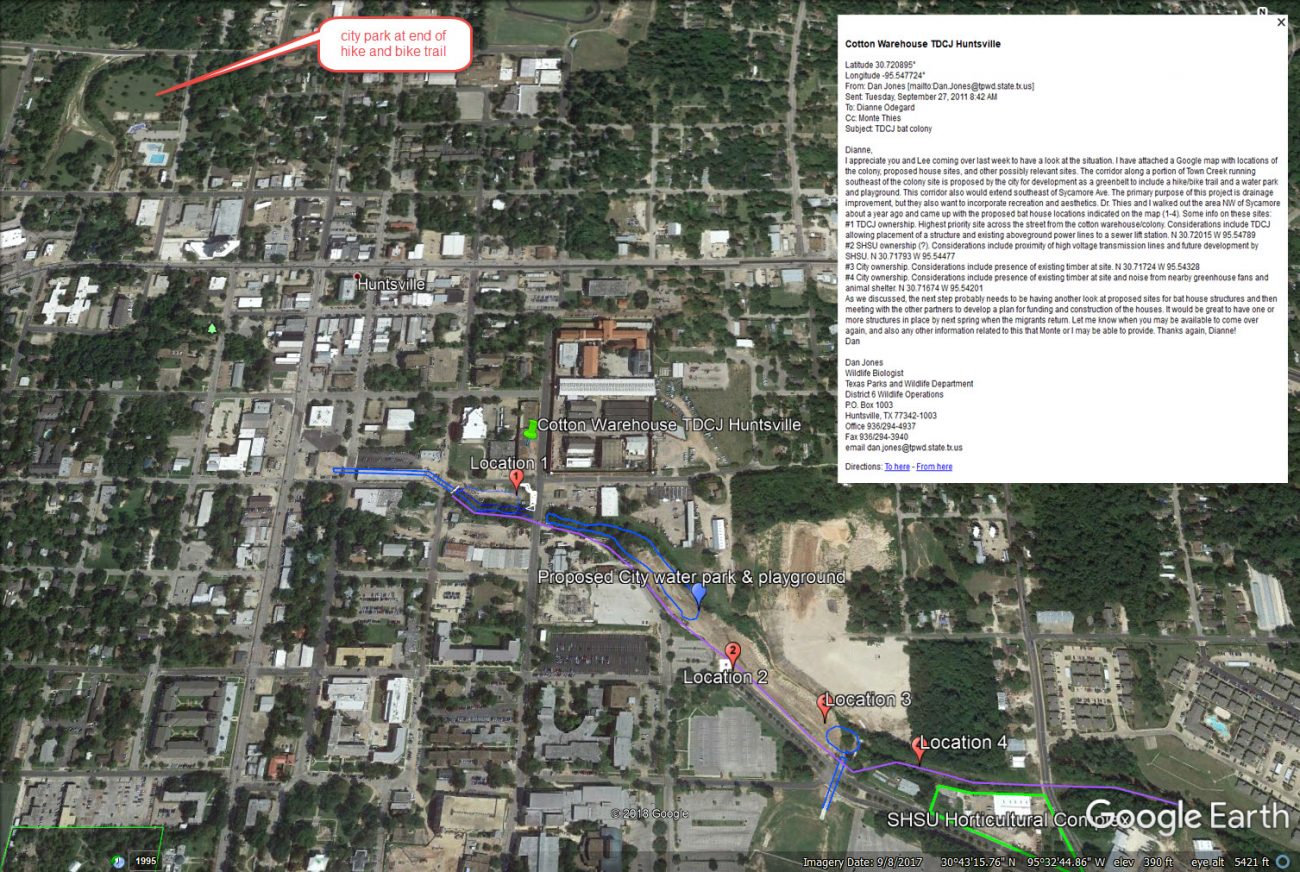
Back in 2011, a plan was in the works to use FEMA funds to address Huntsville’s flooding problems by removing the underground storm drains and creating hiking trails and ponds along the creek flowing near the warehouse. This was envisioned as a riparian corridor connecting Sam Houston State University to a city park on the northwest side as it passed through downtown (from bottom right to top left in image below) . Retention ponds along the creek, that would slow and sink the surface flow, were seen as places for idyllic repose, with benches to allow enjoyment of the ponds and attracted waterfowl. Thoughts arose that mitigation roosts could be placed along the creek at various locations as tourist attractions, where locals and visitors could enjoy the spectacle of nightly bat flights, much as they do today as they gather outside the Walls Unit to watch nightly flights in the summertime.
Here’s what we had in mind back at that time.
Faced with Texas Parks and Wildlife Department’s ruling that the warehouse bats are a protected natural resource (because the roost is in an unoccupied/abandoned building), TDCJ agreed to install community bat houses, and to have them built by shop classes designed to give the inmates construction skills they can use upon release. We liked that idea, and were glad the inmate students would gain construction experience. However, for some reason, the roosts were built using an untested combination of designs, and with substandard roost modules and other issues ensuring a short life of the structures, and questionable occupation by bats.
 The design was never vetted by TPWD’s working group (consisting of TPWD, Austin Bat Refuge, BCI and Sam Houston State University), nor was the amount of mitigation roost space provided by these houses. Our working group was allowed to inspect the first house as it was being constructed at the Woodville unit of the prison system. Our detailed critiques of the design, and requests for modification, were not incorporated by the shop classes and the subsequent three bat houses were completed in exactly the same fashion as the first one. The design was put into production and the result was four substandard bat roosts.
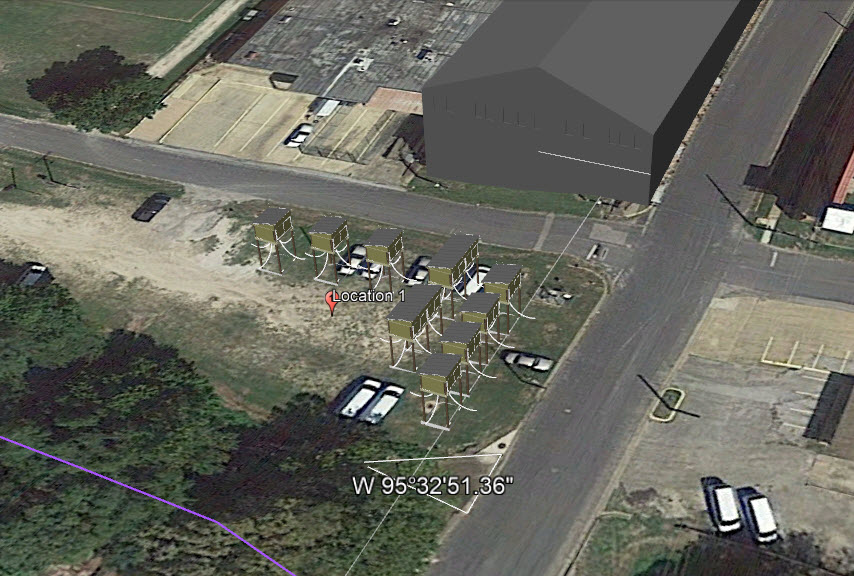
Prison officials also overestimated the number of bats each bat house might hold, and did not consult the working group about estimating the size of the growing colony. The working group had always considered that a much larger number of community bat houses would be required as mitigation for the warehouse colony. Our original idea for the parking lot roosts looked something like this, potentially housing around 400,000 bats:

OR, some combination of double and single bat condos that would accomodate 550k or more bats:
A meeting of the working group with TDCJ on Nov 13th included the presence of Bat Conservation International in the group for the first time since June 2017, which we felt added even more professional credibility to our group. At the meeting, we expressed the working group’s concerns regarding the bat houses constructed by TDCJ and communicated our conclusion that the bat houses were of an unproven design, not well constructed, and inadequate in size to house the colony. We communicated our opinion that, based on our inspections, they do not have enough capacity to hold the size of the colony even as it was in 2011, not to mention the increase of the colony size in recent years.
Bullet points of the meeting:
- TDCJ declared their intention to work with the group and go slowly with any exclusion process, with any major work being deferred until next winter.
- SHSU suggested allowing TDCJ to take advantage of the bats’ winter absence to exclude some of the rooms on the bottom floor.
- It was agreed that exclusion of a few small rooms on the bottom floor would incentivize some of the colony to explore the as-yet unused bat houses, thereby vetting the design and seeing if they would be accepted and prove adequate.
- BCI suggested setting up a walk-through to see if bats were present in those bottom-floor back rooms.
- TDCJ was tasked with mapping the warehouse in order to develop an exclusion plan.
- TDCJ stated they absolutely would not pay for professional exclusion companies to perform or consult on the work.
- ABR volunteered to attempt to line up no cost professional exclusion consultation, to start once the maps were made available.
- Our consultant agreed to work gratis and was awaiting the floorplan of the warehouse to professionally advise on the process.
On March 5th, we were notified that:
- TPWD, SHSU, and BCI had performed a walk-through of the warehouse and found approximately 3500 bats in the upper floor area.
- Apparent miscommunication between TDCJ and TPWD unfortunately resulted in our working group unable to be present for a warehouse “mapping” visit.
- Following their own inspections on Feb 8th and Feb 11th, TDCJ unilaterally mapped the warehouse and drew up their own exclusion plan, with no input from our professionals. They barricaded (did not exclude) the entire first floor and most of the second floor, reducing the available roosting area by perhaps 80%, and possibly trapping any bats hiding in those areas.
- Warehouse mapping was submitted to TPWD on Feb 11th, but was impossible to vet without the floorplans.
- During their unlilateral process, TDCJ closed the traditional entry/exit point, a loading door on the east side of the warehouse, the one bats had been using for decades. They opened up small windows on the south side that never previously connected to the main roosting areas.
- TDCJ said that “Our failure to act on this would allow the returning colony to have access to the entire warehouse, making it virtually impossible to execute a proper plan of exclusion. The area that the bats are confined to is approximately 4,844 square feet of usable space. Of the bats that are currently in domicile, they only take up a small fraction of existing usable space. At this time we are poised to remain at ease until the migratory return flight and subsequent settling period of the main colony. Upon discovery of return and settlement, we will then expect the execution of the exclusion plan to begin.”
This seems to indicate that they plan to exclude bats at the most vulnerable time for this colony–maternity season–the absolute worst possible time for exclusion activity.
TDCJ and our working group had agreed that only about 10% of the building be excluded in the winter of 2018-19, and that incremental exclusion would slowly incentivize the bats to adjust by using the bat roosts provided by TDCJ. If it was determined that the bat houses functioned properly and were of sufficient capacity, the exclusion would take place the following winter.
Return of the bats, one week from our notification of these events, to vastly modified conditions and unproven mitigation roosts, will certainly lead to mass mortality (from exposure and predation) and increased incidence of bats in buildings in the area around the warehouse.
We hope they will open the roost entrance and used for over a decade by these bats and restore the roost to pre-barrier conditions, so that a measured, responsible solution can be achieved.
Proposed mitigation roost design
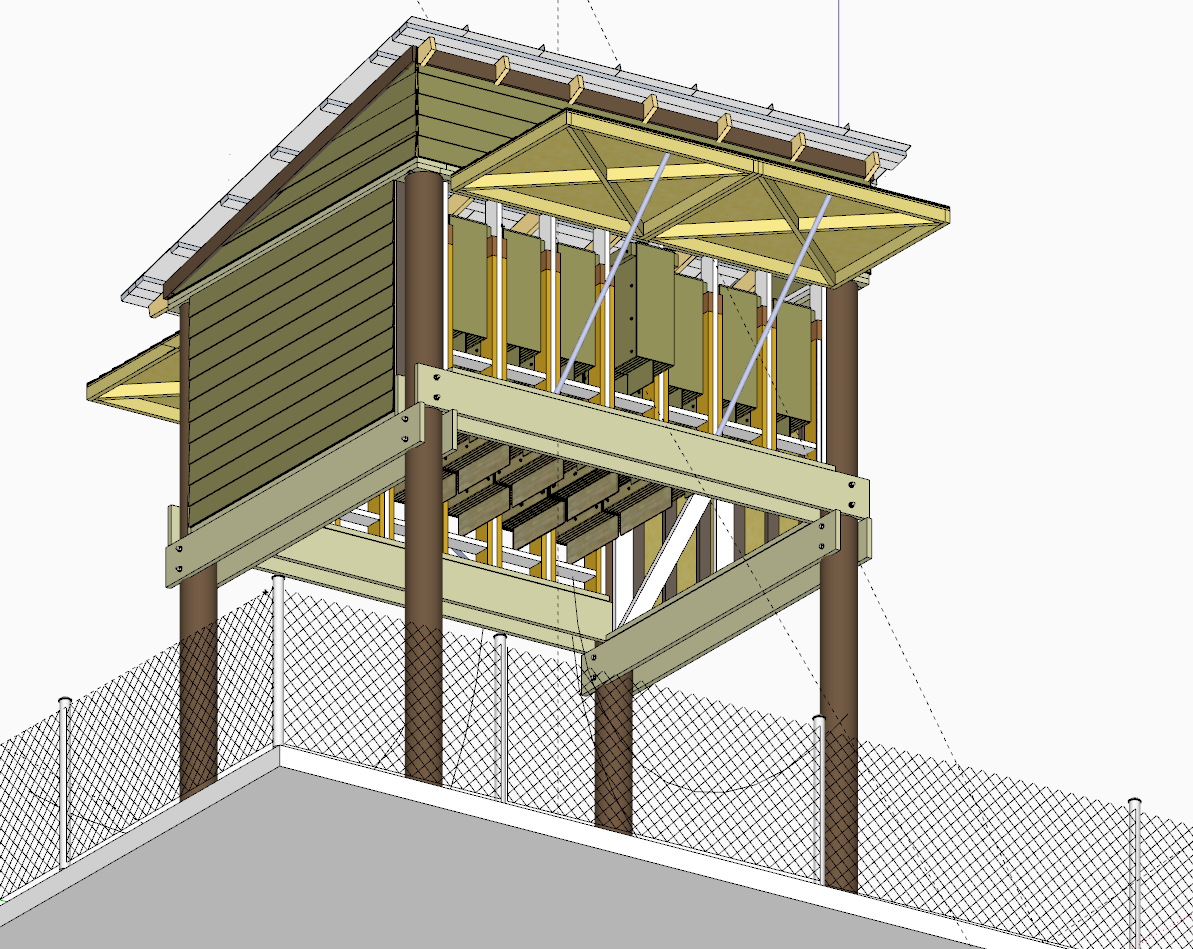
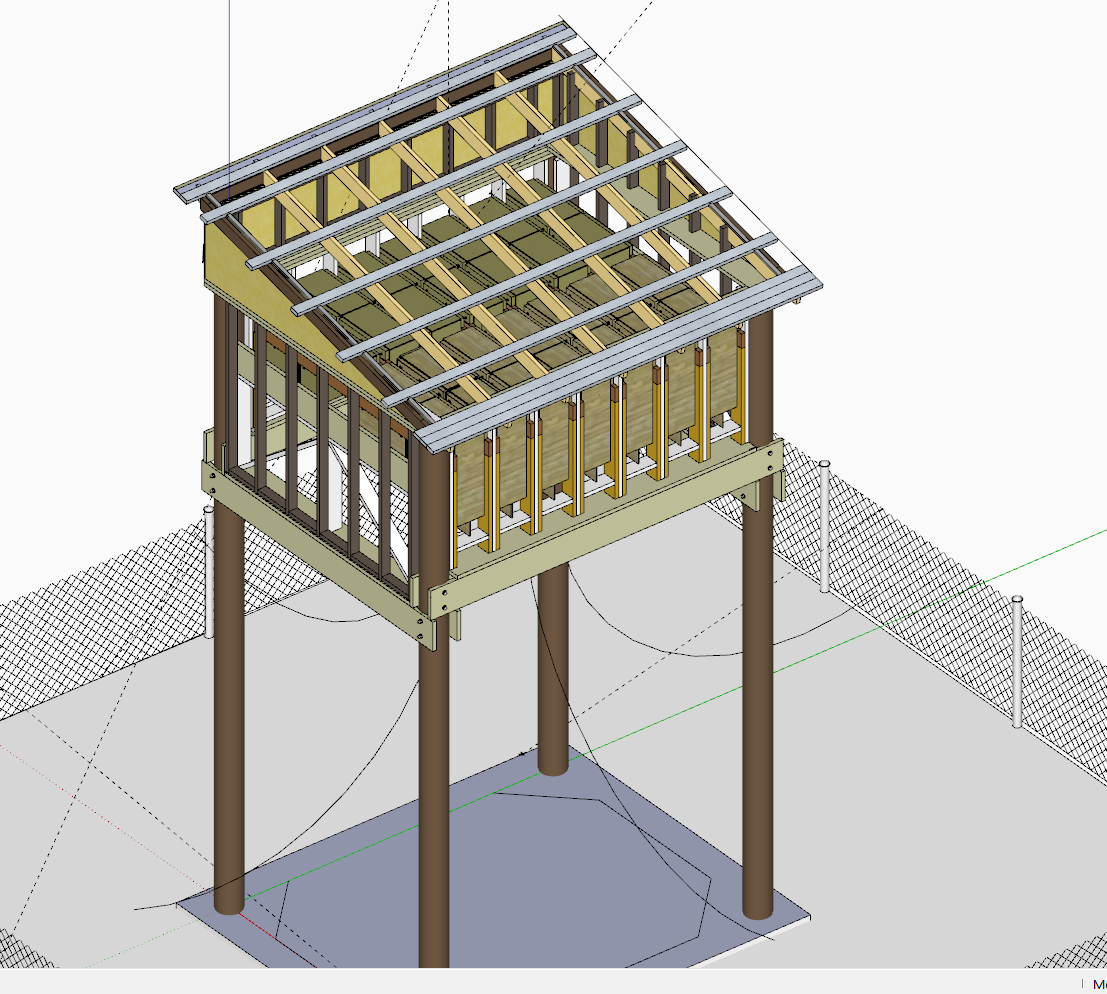
Critiques of TDCJ design that were not implemented