Austin is blessed to have the largest urban bat colony in the world in the heart of downtown at Congress Avenue Bridge. They are Mexican free-tailed bats, a species whose natural habitat is caves and fissures in cliff faces. To them, the city skyline that has erupted around the bridge resembles nothing more than an immense cliff dwelling with caves, prime real estate for bats. It’s up to us not to invite them into places where they are not welcome. Certain areas of buildings will attract bats and we should make sure these areas do not allow bat entry due to incomplete design details, sloppy construction, or deferred maintenance.
However, around the world, bats are subject to brutal techniques for their exclusion usually involving directly killing the bats.
We can do better.
Each year, we consult with various building owners and managers on minimizing bat-human conflict. We perform occasional exclusions in-house, and we can recommend other professional ethical excluders for larger jobs.
Anyone can create ethical bat exclusions in their homes and office. Read below for various steps and resources on how to perform relocations and create habitats for bats that don’t involve their unnecessary death as “pest control”.
Minimizing Harm to Bats during Relocation
In the US, bats have little legal protection in inhabited buildings, compared to places like the United Kingdom where it is illegal to disturb bats roosting in homes or buildings without consultation with a government wildlife professional. Bats can live in the voids of buildings for years in peaceful coexistence with humans. However, if they simply must be relocated, we can minimize harm to bats by following the steps below.
- Exclusions should never be performed during baby season, generally from mid-May to mid-September in the Austin area, nor during winter. Non-flying pups would be trapped. Bats can remain in torpor for an entire month of cold weather without flying.
- Don’t simply wait until after the bats fly and seal the entry/exit points. Not all bats fly each night. This method will inevitably trap bats inside, killing hundreds or thousands of bats that did not fly that night and causing more potential for conflict with humans as bats seek other exits through the living or working space.
- Secure the interior envelope first. Seal wall and ceiling pipe penetrations, attic stairs, ductwork leading to the attic or exterior, unfinished walls in utility rooms, etc.
- Close large sections of each entry point, while placing enough exclusion tubes so that bats don’t panic at flight time. Small-meshed netting (OV-7822 purchased at industrialnetting.com) could be used on long crevice-like entry points if bats customarily emerge from all along the crevice.
- Any excessive restriction of their normal exit (perhaps by using too few exclusion tubes) will cause some back pressure, causing bats to fly back into the structure to find an easier way out. This can be a problem if the interior envelope is not sealed.
- Creativity is needed in some odd-shaped areas, but stiff 1/4″ netting (again OV-7822 purchased at industrialnetting.com) can be shaped to fit and combined with exclusion tubes using staples and water-based adhesive caulk. Large boxes of netting can be fashioned around single exit points that accommodate multiple exclusion tubes, causing less back-pressure.
- Empty caulk tubes can be cleaned out and fashioned into more exclusion tubes.
- Get an early start when installing exclusion tubes. Any caulk used around the openings must have plenty of time to dry before the bats fly.
- In unfinished areas, polyethylene sheeting could be installed like a dust barrier, confining bats to a smaller area near the exit so that they re-direct themselves out through the exclusion tubes.
- Exclusion tubes should be left in place for at least two weeks of good weather, to ensure all bats have been hungry enough to fly out to feed.
- After that time has elapsed, the entry/exits can be sealed using the same materials with which the buildings are constructed.
Certain locations on buildings, such as overhangs, will naturally attract bats. They commonly seek areas such as these to shelter from inclement weather and to hide from avian predators. If such portions of buildings also have warm air leaking out, then these areas will become bat magnets during cold weather. These areas must be constructed and maintained to prevent bat entry. Architects must draw details to show how they intend to screen expansion joints and air intakes from bat intrusion. Caulks and sealants degrade and fail over time are not a great solution to denying access in and around such areas. LEED credits should routinely be awarded for building designs that avoid inviting bats to take up residence where they are not wanted.
If these details are not worked out in advance, then developers are simply passing down the cost of a bat exclusion to the future owners and tenants. These particular Life Cycle Costs of the building should be anticipated and paid for up front by the developers. Then contractors need to be paid for and contractually obligated to soundly construct those details.
Building managers should routinely inspect the exterior envelope of their buildings and maintain areas of potential problems. If there are signs of bat entry, such as visual confirmation of bat flights or stains from the body oils of many bats, then an exclusion must take place before re-sealing the areas.
In the top floor of commercial spaces, the ceiling is usually comprised of acoustic tiles, inserted into an aluminum gridwork suspended by wires from the roof. These drop ceilings must be kept intact to seal the working space. Replace these lightweight tiles when corners break off and make sure maintenance workers put them back if they are moved to gain access for electrical work. Wires suspending the grid will act as a “harp trap” for bats forced to fly in such areas, causing them to drop as they hit the wire and become impaled on the twisted end of the wire (such pig tails should be angled tightly downward to avoid this). Prevent bats from flying in such spaces by installing polyethylene sheeting prior to exclusion. We have seen exclusion back-pressure cause large numbers of bats to be trapped in open wall cavities, impaled on ceiling grid wires, and stuck on old glue traps left for rodents.
How to Determine if You Have Bats
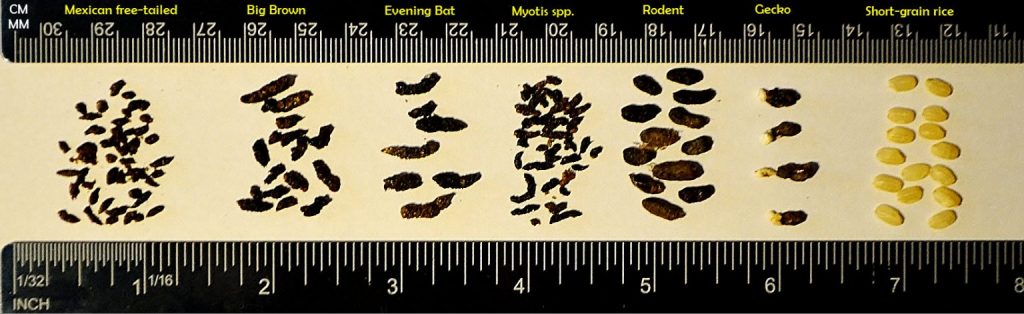
It is usually not necessary to enter an attic, basement, or other area to look for bats in structural voids (the spaces between exterior and interior envelopes of a building). Evidence that bats are occupying voids includes seeing them entering or exiting a roost, staining and guano accumulations near active roost entries, audible roost chatter (high-pitched chirping), a distinct musky odor, or repeatedly finding bats on the ground or roosting on an exterior wall.
The size and shape of bat guano differs among bat species, but what all insect-eating bat guano have in common is the presence of shiny insect parts in the droppings, and the dry, crumbly texture. Bat guano can sometimes be confused with gecko, lizard, frog or rodent droppings. Rodent droppings are similar in color and size, but are hard and not easily crushed. Gecko droppings are soft and easily crushed, but pellets are tipped with white uric acid deposits not found on bat guano.
How Your Local Business Can Help Bats
It is a business’s duty, especially green businesses, in Austin (aka Bat City), to acquaint themselves with Best Management Practices for peaceful coexistence with bats. They should know what questions to ask the companies they hire to manage bat intrusions. We plan to reach out to all businesses in Austin to make sure they are acquainted with our BMPs. This list would include developers, property managers, commercial tenants, realtor associations, apartment manager associations, owners, renters, and pest-control companies.
Each year we consult with scores of building owners and managers on minimizing bat/human conflict. We perform occasional exclusions in-house, but we normally recommend other professional excluders for most large jobs. Austin’s bats are an ecological treasure and when they need to be relocated, it is a conservation matter, not a pest-control issue. In addition to Austin Bat Refuge, there are many ecological consulting companies around Austin who could be called upon for advice about safely relocating bats. TXDOT routinely consults with such agencies about bats in bridges; developers and property managers could do the same for bats and buildings.
Bats find shelter in cold weather by following warm air leaking from buildings. By doing so, they are performing free Energy-Auditing Services, adding to their long list of environmental benefits. Use of terms like “infestation” or phrases like “attacked someone” mischaracterize the actions of animals trying to survive arctic outbreaks or trying to avoid capture by what they assume to be a predator.
We humans have been sharing our domiciles with bats since the days of the cave people, and bats have always been great neighbors if simply left alone. They have a great safety record living among humans way better than that of our beloved household pets. That being said, we don’t want bats in our living or working space. They have been known to roost for years in the voids of buildings (like wall cavities) without causing any trouble. As long as the interior envelope of the living space is sealed, there is no danger to humans.
It is important to keep that interior envelope sealed, especially pipe and duct penetrations through ceilings, both for energy purposes and for unwanted intrusions. Bats sometimes drop guano in unwelcome spots, say below roof eaves onto pool aprons, or in front of entry doors. That alone may be a valid reason to ask them to relocate. If this becomes necessary, sealing the interior envelope of the living space should be the first step in an exclusion. This prevents any possible health hazard while awaiting exclusion season.
Our Exclusion Work
This video features our exclusion of a Mexican free-tailed bat colony which had multiple access points in a barn-style home with rustic, live-edge pine siding. It required a combination of carpentry and wildlife skills. The homeowner was newly widowed and needed to sell the house, so our first choice of simply letting the bats stay was not an option. We performed the exclusion at cost, using stiff 1/4″ netting and recycled caulk tubes. Please enjoy some of our rehabilitating bats in the video (Credit: TPWD) as the bats look back at you through the exclusion tubes alongside the beautiful Texas sky.
Bat Exclusions
Check out our Bats & Buildings brochure for helpful tips about safe and humane bat exclusion.
Additional Resources
Education
- Bats Live – Prince William Network
- Bat Pack – Aussie Bat Resources – Bat Activities
- Bat Echolocation Research Handbook 2020 – A handbook for planning and conducting acoustic studies
- The Austin Environmental Directory – A comprehensive sourcebook of green organizations, issues, products, and services
- austinbats.org